Showing posts with label 2017. Show all posts

30 Nov 2017

Christmas markets: Nürnberg Weihnachtsmarkt

Christmas market by night

Nürnberg - this place don't need a special invitation, especially before Christmas. Except values of the city, you can take part in one of the oldest Germans Christmas market: Nürnberger Christkindlesmarkt which means exactly: "Christ Child market".

View on the Nürnberger Christkindlesmarkt

The Christmas market is located on the main town square (Hauptmarkt) and the easiest way to get there is to use a public transport - bus and metro stops you can find on the map below. If you are coming from another city, you can use a train (DB) or more comfortable way - a car. For drivers we marked the spots, where the free parking places are located. You won't find any free parking place closer to the old town.
Organizers didn't forget about kids. They have theirs own Christmas market located on the St. Lorenz square. Although, it is smaller, you can find the most beautiful carousel (not only for kids) :)))

Map:


Read more »

24 Jun 2017

Schwäbisch Hall - small town on the slopes of the valley

Welcome to Schwäbisch Hall

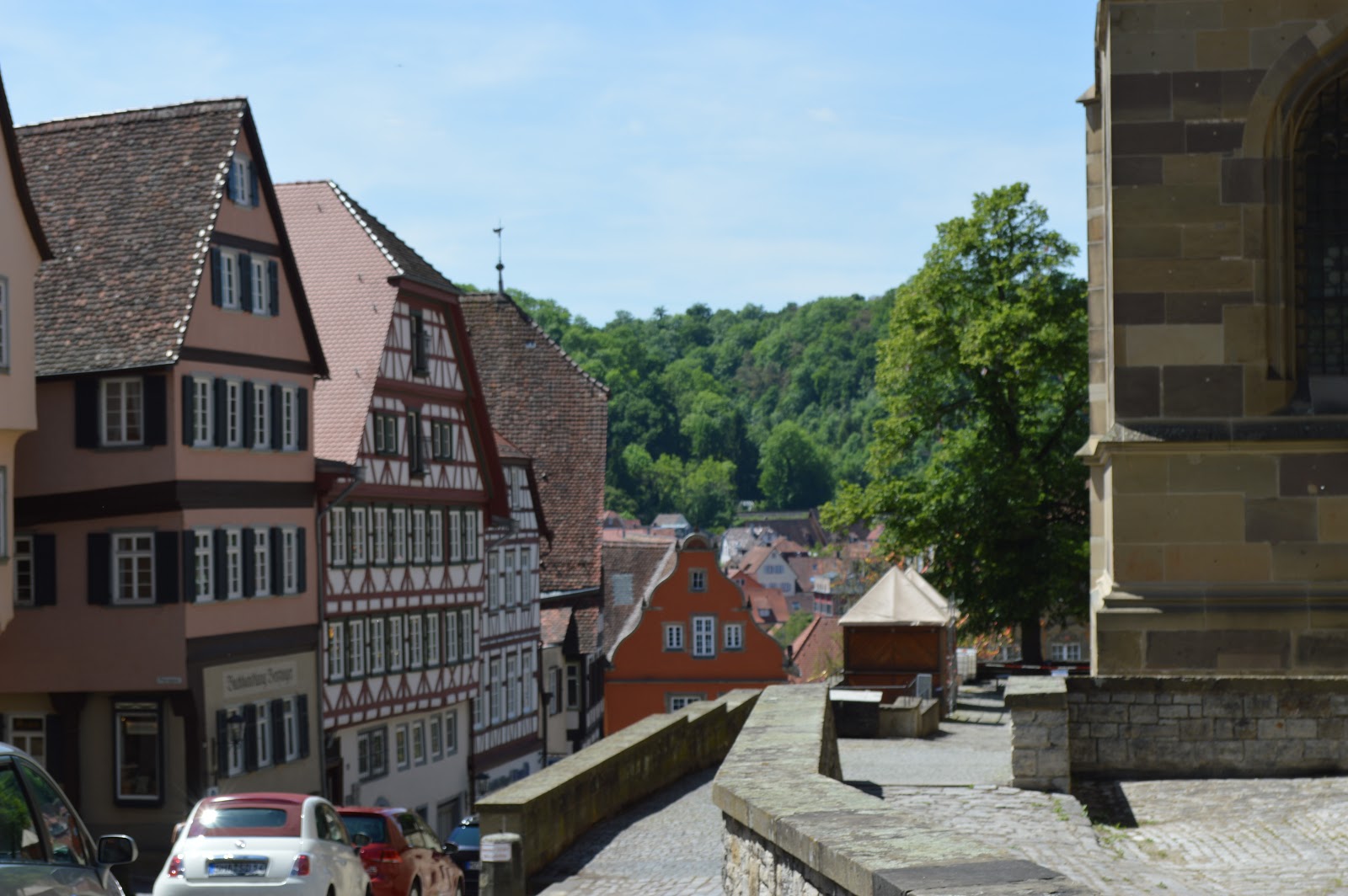
Schwäbisch Hall is a medium sized town in Southern Germany. It belongs to the province: Baden-Wurttemberg. The town includes mixture of old and modern buildings, but the old ones are very well preserved and picturesquely situated at the banks of the Kocher river. The river is situated in a valley, therefore the old town is located on the valley slopes, which gives even nicer impression. 


Can be misleadingly considered as the most famous view of Rothenburg


Second Rothenburg?


The climate inside the old town is very comparable to Rothenburg ob der Tauber, which is considered to be one of the most famous medieval towns in the World. What differs the towns the most is the landform (Rothenburg is located almost on the equal level). Buildings built on the slopes has two completely different ground floors and this makes them look even more cute - the masterpiece in building on the slopes we saw in Frias. On the other hand, only the residual parts of the town walls are preserved in Schwäbisch Hall. In Germany there are only three towns, which are surrounded by medieval city walls till this day, they are: Rothenburg ob der Tauber, Dinkelsbühl and Nordlingen.


Main square


St. Michael's church located at main square of Schwäbisch Hall


Level difference seen on the main square of Schwäbisch Hall

The main square in Schwäbisch Hall is very typical for medieval town. There are located: Town Hall, Church, some beautiful buildings and between them there is huge place. Although, we called it 'typical' it looks very nice and cozy.

Town Hall of Schwäbisch Hall


Old town streets


Every street you would go from the main square you will feel the medieval climate. The streets are more narrow then in similar towns, because of the slopes. It is also very common that the buildings are expanding looking at following higher floors. 

Street in the old town #1


Street in the old town #2

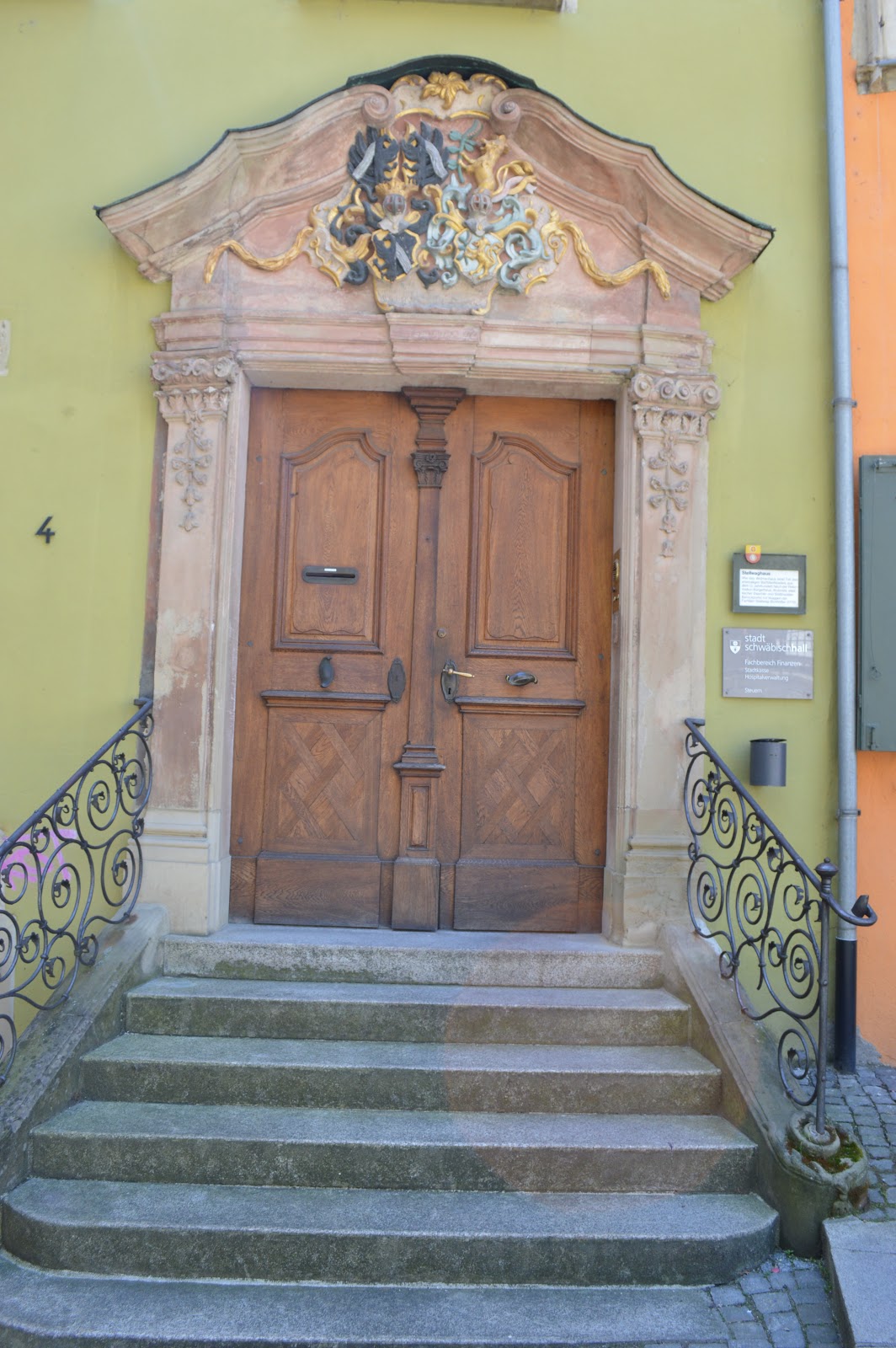
The medieval art was really developed in this region, which also testifies of the richness of the town in the past. There are more than few richly decorated portals (we cannot name it longed doors), which example you can see below. 


Schwäbian little Venice


Schwäbian little Venice

We already got used to compare any town which is nice and has some water in between to Venice. Therefore, we will also point it out here, there are three small islands connected with wooden or stone bridges, where nowadays people spend free time enjoying the regional beer.

Small advertisement, the beer was good - as always, we took the wheat one:)


Dragons in the city


Dragon holding the signboard

During the walk through the town we observed several likenesses of dragons, not only on old-styled signboards, but also in gargoyles. But we have no ides if the dragons has any special meaning for the town's history.

Dragon's head as a gargoyles


Modern art


We are not the artists or any Art experts, but these extraordinary handrails also caught our attention.

Handrail part 1

Handrail part 2


Grosscomburg


View on the monastery from the entry road

Driving or walking though the Schwäbisch Hall you can see (a little further) the small 'castle' on the hill. In fact this is the benedictine monastery which was built even before the town. The monastery is well fortified and it was used not only as place of prayer but also as a defense fortress. It is definitely worth to visit it, while doing the trip to Schwäbisch Hall. 


Gate to the monastery


View on the courtyard form the monastery walls


All mentioned places you can easily find on a map below:


That's all for today...

...we hope you enjoyed!
Read more »

10 May 2017

Loket - following the Goethe's trail

View on the Loket town

Loket - a biref story


The town's history began in XIIth century, when the Loket castle was built. It was used as a boarder fortress. Later on the city next to the castle was developed (XIIIth century). In Loket the Holy Roman Emperor - Charles IV lived (the one who discovered hot springs in Karlovy Vary). Therefore, the town gained the 'royal city' status. By the end of the XVth century Loket was one of the best fortified cities in Central Europe. It was destroyed during the Thirty Years' War and after this it never came back to its previous splendor. Thanks to this lot of monuments preserved in unchanged manner till this day. Nowadays, the town only has around 3 000 inhabitants.

Beutifully located town between mountainsin a river bend

Follow me through the town's streets
Read more »

30 Apr 2017

Romantic Road: Rothenburg ob der Tauber - taken out of the Middle Ages

Most beautiful scene in the town

Rothenburg od der Tauber is our next stop on the Romantic Road (マンチック街道) though Bavaria and in our opinion is one of the bast places on this tail, because...

Town walls:


It is one of the three German cities which are still fully surrounded by medieval city walls. The other two are Dinkelsbuhl and Nordlingen, also in Bavaria and  they also belongs to the Romantic Road.


The gates to the city are not changed for at least 600 years. Thus they are normally a bit thin as for today's traffic and the cars have to wait for each other to drive through. Moreover, you can meet there many carriages. All entrances to the city consist not only from a gate but also from a tower, which differs from one to another:


Moreover, the walls were surrounded by the moat, which past presence can be observed in few places... 

Bridge for pedestrians over the old moat

 After we went into the town of Rothenburg od der Tauber, we were a little bit surprised that the city walls can be fully accessed by the tourists. So, let's follow me...

Read more »

12 Mar 2017

Herzogenaurach - the motherland of sport shoes

What this ball is doing here?
/photo from 2015


If you are a big fans of sport (as we are), and you know brand like ADIDAS and PUMA you have to read this post! Then, the answer for question "What this ball is doing here?" will be easy to answer :)
Enjoy!


Between two towers


Herzogenaurach is a small, old town with ca. 20 000 inhabitants. It is located near Furth, Erlangen and Nurnberg, over a river Aurach in Bavaria, Germany. Location in vicinity of such well known cities makes it for most of the people unnoticeable. However, this is the place where lot of people want to live and work. The old town can be walked through in 5 minutes, but the architecture of the town makes this walk very pleasant. While entering the town from the East side you will pass by the overgrowth with ivy 13th century Fehn Tower (below on the right), which first marks the boundary of medieval inner city and second was used as a prison. From the other side the town is "protected" by Lookout Tower, built in 14th century (below on the left).


The Fehn Tower has 28 meters height, and you can visit it with a tour guide. 
The Lookout Tower was the part of the inner city wall and on the main wall of the Lookout Tower you can find an old coat of arms of Herzogenaurach.
Between two towers (which are separated by around 200 meters), you find the most beautiful buildings of Herzogenaurach.

An old coat of arms of Herzogenaurach on Lookout Tower


A newest version of coat of arms of Herzogenaurach on Fehn Tower

All buildings in this town comes from middle ages, which makes the climate of the town very nice. Some of them still have unique sign referring to the "craftsman time".


 On the North side of an old town there is located a church St. Magdalena (below) and a small "castle", which is now used as town hall. This is the mix of the roman style building from 13th century and gothic nave. On a main square there is located an old town hall (Altes Rathaus), in which now you can find a restaurant (below on the left).

Read more »

15 Feb 2017

Karlovy Vary - where the hot water springs

Main geyser on a street in Karlovy Vary

A brief story:


Karlovy Vary (Karlsbad, Carlsbad, カルロヴィ・ヴァリ) is located in western Czech Republic. It was founded in 14th century after the accidental discovery of the hot springs by the king Charles IV during his hunting in the region (the emperor at this time lived in nearby castle Loket). The town is located along the river Teplá, which from Czech means hot, as the water from springs finally always falls into this river and makes it a bit hotter than expected.

River Teplá in Karlovy Vary

The golden age of the town falls on the XVIII - XIX century, from when most of the buildings comes from. These times tourists started to visit the town and the springs, as the transportation became easier. From the second half of the XIX century rich clientele started determining the character of the society in Karlovy Vary. During this time many political and diplomatic negotiations took place in this town.

Living in a spa.


In the town there are 13 hot main mineral springs, which differs from each other by temperature and amount of minerals.  There are also about 300 smaller springs. The hottest spring is called Vřídlo, which temperature is equal 73 degrees Celsius and it rises from the depth of 2000-3000 meters. The temperature of other springs varies between 30 and 70 degrees. The water from the springs can cure metabolic disorders and/or be used for inhalations.  


Vřídlo hot spring

Read more »